No one could see how the work actually flowed. That was the whole problem.
How I mapped an invisible, siloed delivery operation, built the single source of truth that automated the work behind our core product, and cleared the operational bottleneck that had been capping the company's growth.
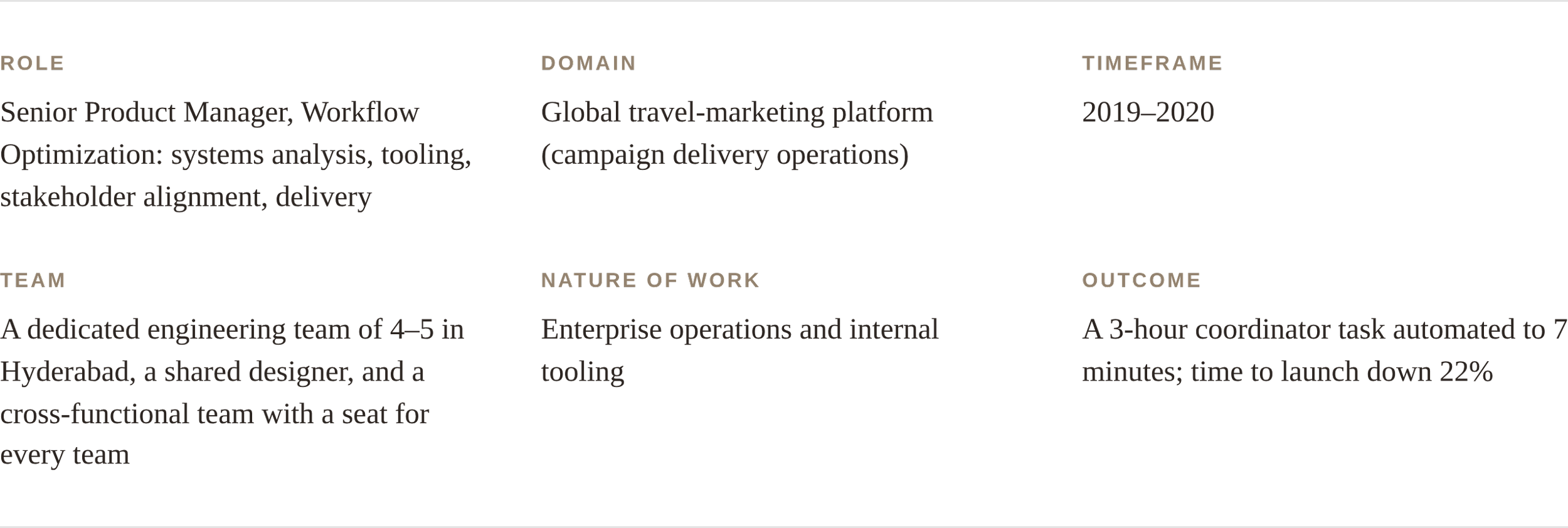
01 THE SYSTEM
The business knew it couldn't scale. It just didn't know why.
Everyone agreed the operation was slow and manual, but no one could actually see how a campaign got from a signed sale to final delivery. The work was split across teams, and each team only knew its own piece. There was no shared picture of the whole.
The people who felt it most were the campaign coordinators in operations, the ones responsible for getting campaigns live. They had the worst tools, the most manual steps, and almost no room for a mistake or a late launch. When the process failed, it failed on them.
And campaigns were the business, its bread and butter. The slower and more manual their delivery, the harder a ceiling it put on how much new business the company could afford to say yes to.
My title was "Workflow Optimization." The first move wasn't to optimize anything. It was to make the work visible.
02 WHAT I DECIDED
DECISION 01 · SEE IT FIRST
Map the whole operation by hand, from sale to final delivery, before changing a thing.
I built the flow chart myself: every step it took to deliver a campaign, end to end. It was eye-opening, and not just for me. Once teams that had only ever seen their own slice looked at the whole thing together, no one could un-see how inefficient it had become. That shared picture is what made everything after it possible.
DECISION 02 · ONE SOURCE OF TRUTH
Replace the manual, siloed process with a single place the whole campaign lives.
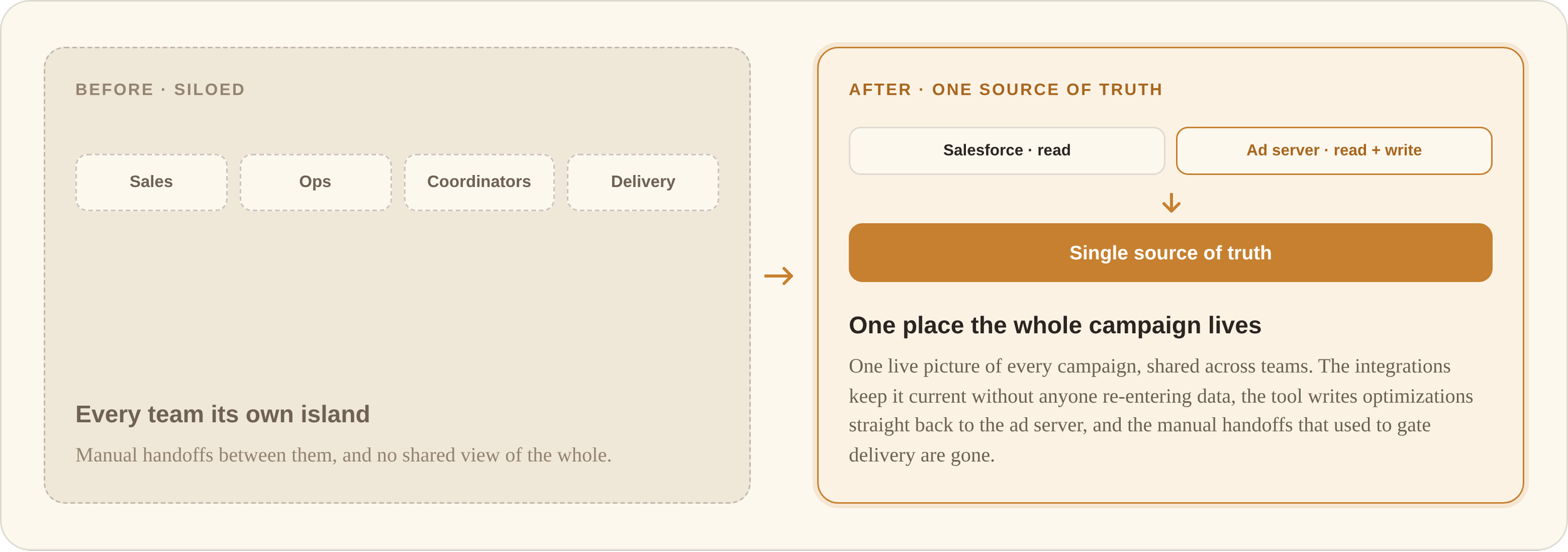
I championed building an internal tool and dashboard that became the single source of truth for the campaign lifecycle. It read campaign details in from Salesforce, and it connected to the ad server both ways: pulling live delivery numbers in, and pushing optimization changes back out. That two-way link is what turned the coordinators' manual, three-hour task into something the tool could do in minutes. Fewer handoffs, and far fewer chances to get it wrong.
DECISION 03 · CHANGE IT WITH EVERYONE, NOT AT THEM
Run it as a cross-functional team with a seat for every team the work touched.
A workflow redesign only sticks if the people who live in it help build it. So I started a cross-functional team with one person from each team in the company, because this work touched all of them. They kept the redesign honest, and they carried it back to their teams.
03 WHAT CHANGED
The models and maps behind the decisions.
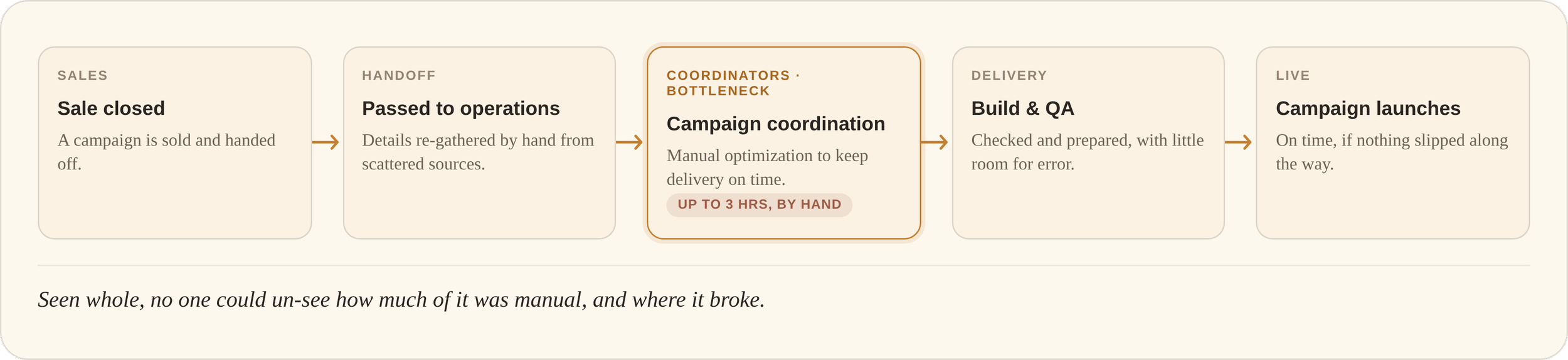
The end-to-end delivery map
Everything it took to get a campaign from a signed sale to live, drawn in one place for the first time. Each step had belonged to a different team, and no one had ever seen the whole path at once. (Illustrative of the flow I mapped.)
Before and after the operating model
From siloed teams doing manual handoffs to one shared source of truth every team could see and feed.
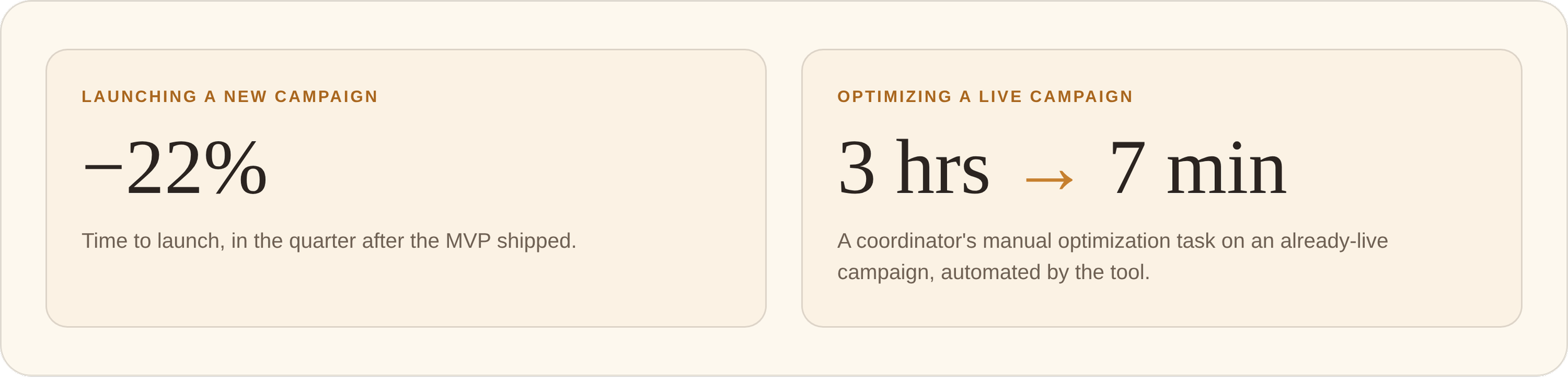
Two results, two different stages
Two separate wins, not one flowing from the other. One made launching a new campaign faster; the other automated a task on campaigns that were already live.
04 WHY IT MATTERED
This was never about speed for its own sake. It was about capacity.
Campaigns were the business, its bread and butter, and the manual operation behind them had become the real ceiling on how much the company could take on. Automating that work changed the equation. One shared source of truth replaced the siloed handoffs, the room for error shrank, and the coordinators were freed from the worst of the load they had been carrying.
The operation was no longer the bottleneck. The business was finally ready to take on the additional volume it had been wanting, without the delivery machine buckling under the weight.
And this was only the first step. The plan was a deliberate roadmap: go team by team, plug each one into the same source of truth, and optimize its specific workflow in turn. This first build was the proof of the model the rest would follow.
WHAT I CARRY FORWARD
Before you optimize anything, get everyone looking at the same map. You can't fix what no one can see.
From the Team
“Liz was a crystal clear communicator… and never left a stakeholder in the dark. She led with authority during her time at Sojern, making her a highly effective PM.”
— Product Leader
“She spends copious amount of time with her product’s users and translates the insights to solve their problems into detailed product features. With this approach, she amplifies the engineering team’s effectiveness in the delivery of the product feature.”
— Technical Collaborator