Engagement was not the problem. Relevance was.
I was handed an engagement problem and found a relevance one. By redesigning how care reached people (through their assessments, our messaging journey, and the moments between sessions), more clients made it to a third session, and the longer-term care that follows.
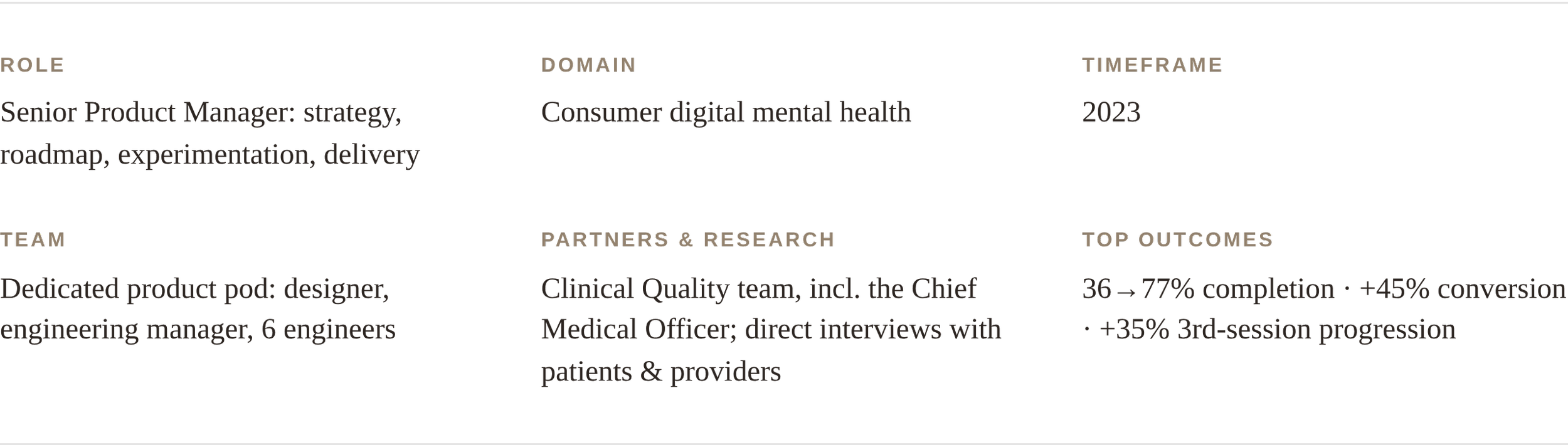
01 THE SYSTEM
I was handed an engagement problem. Getting to the root of it changed the diagnosis, and everything that followed.
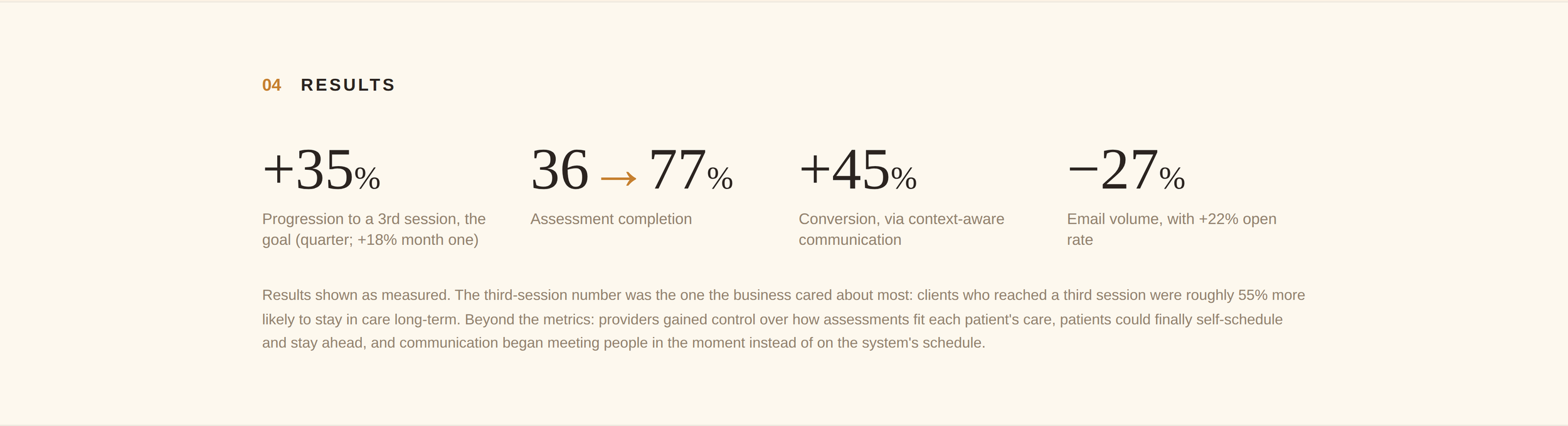
The goal was specific and well-founded: get more clients to a third therapy session. We knew that clients who reached a third session were roughly 55% more likely to stay in care for the long term, so that third session was the threshold that mattered most. I was asked to raise it, on the assumption that clients simply weren't engaged enough.
So I went to the people. Talking with patients and providers, a different picture emerged. Patients arrived ready to do the work, but whether the platform met them there depended almost entirely on which provider they were paired with. A motivated patient would take an assessment, show up, and want something to hold onto between sessions; but between-session tools only existed if their provider assigned them, and many didn't. The person most ready to make progress was left with nothing at exactly the moments care needed to feel present.
The friction ran both ways. A patient couldn't book their own next session at all, so they had to message their provider and wait, a small task that quietly became a barrier for both. And patients would gladly complete assessments, but not every provider used them: with no fast, scannable way to read results before a session, the concerning signals called out, assessments felt like busywork, so patients stopped.
It was never an engagement problem. It was a relevance problem. We weren't meeting patients or providers in the moment, and in-the-moment care was exactly what we were trying to move toward. Naming that correctly is what made the next decisions obvious.
Three calls, each about meeting people in the moment rather than optimizing a number.
02 WHAT I DECIDED
DECISION 01 · COMMUNICATION
Rebuild the communication journey from the ground up, rather than patch a system that had learned to talk over people.
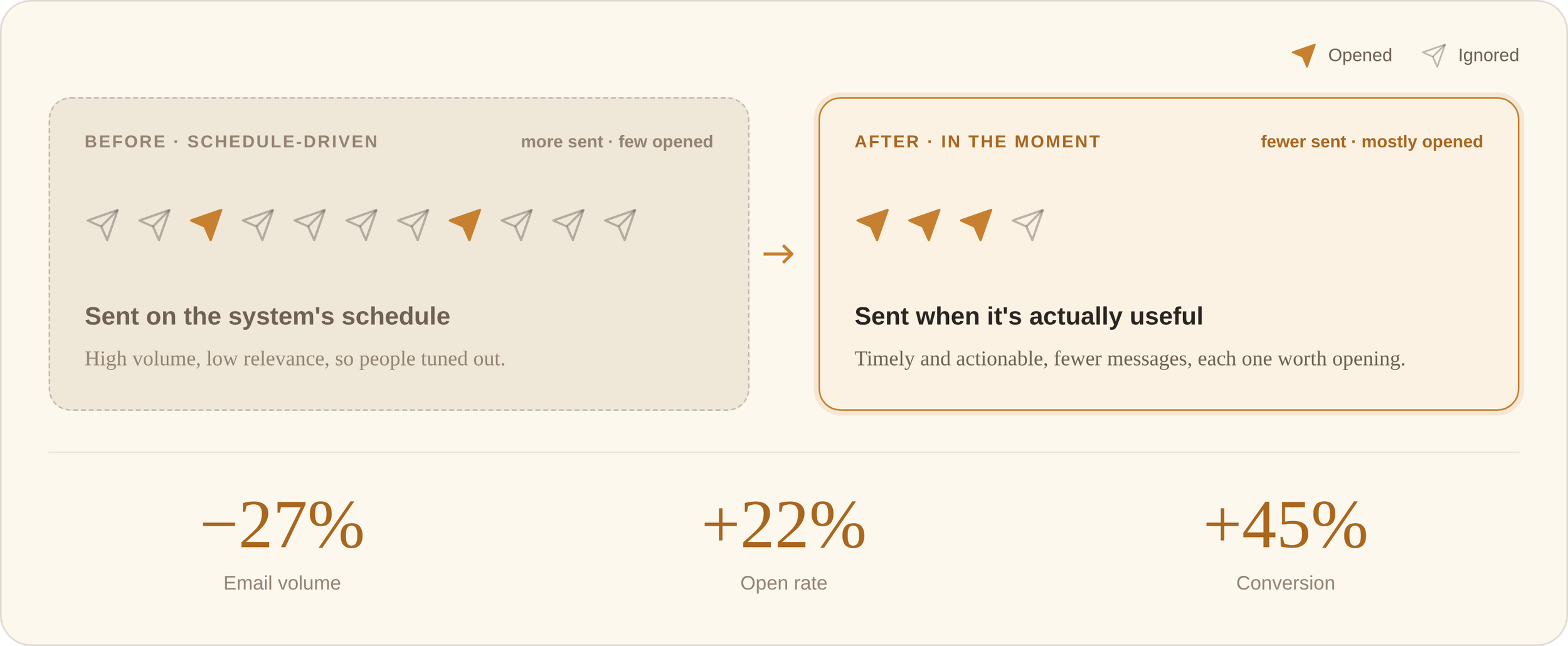
The messaging rules had piled up over the years into something that reached people on the system's schedule instead of their own, and you could feel it. I decided that tuning it would only preserve the wrong foundation, so I rebuilt the communication journey end to end and moved it onto a more capable, stable platform. The point was never more messages; it was messages that showed up when they were actually useful and were worth opening.
The tradeoff was real: rebuilding meant a migration and a slower road than a quick fix. I made that call because a system that talked over people wasn't worth carrying forward, however much history it had.
Email volume −27% · open rate +22% · conversion +45%
DECISION 02 · ASSESSMENTS & CARE BETWEEN SESSIONS
Turn assessments into the engine for care between sessions, and put providers in control of all of it.
There was real pressure to require assessments for every patient: the fastest way to move the completion number. I chose not to. When I sat with clinicians, they were clear: they wanted to decide when an assessment genuinely served a patient, right down to the baseline ones, because that judgment was part of caring for someone. Mandating would have bought a metric and cost me the trust of the people delivering the care. So I handed providers the control instead: opt a patient in or out, on a cadence they set, one patient at a time.
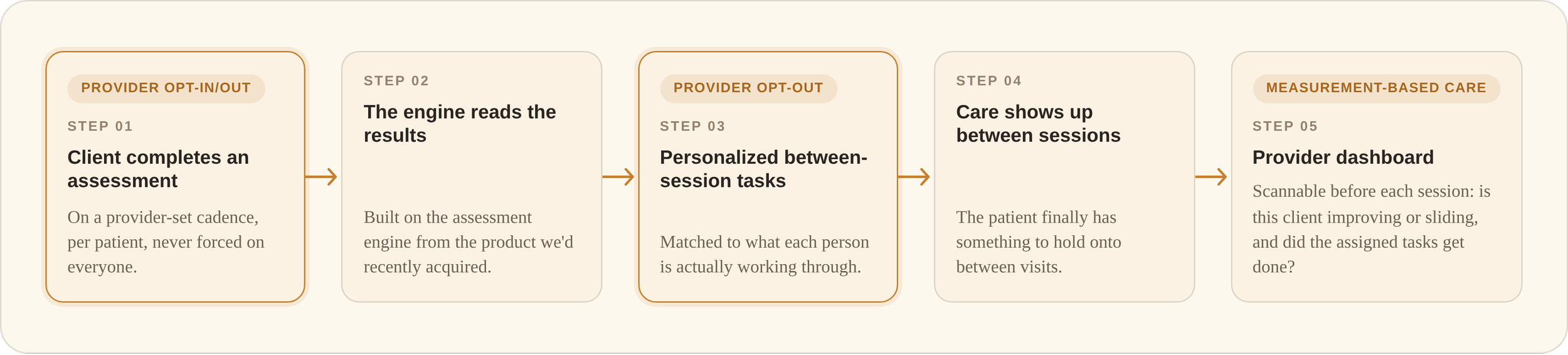
Then I used those same assessments to solve the problem sitting underneath the whole case: the patients who showed up ready to work and had nothing to hold onto between sessions. We turned assessment results into personalized tasks: real between-session work, matched to what each person was actually going through, built on the assessment engine from the product we'd recently acquired. And because providers had told me they wanted to stay in charge of their own practice, they could opt an individual client out of that too. Assessments stopped being a box to tick and became the thing that kept care present between visits.
And I closed the loop back to the providers. Assessment results and task completion surfaced on a dashboard they could scan before each session: is this client improving or sliding, did the assigned work get done. That's measurement-based care in practice: the next session starts from where the client actually is, not from guesswork.
Assessment completion 36% → 77% · between-session support that finally existed
DECISION 03 · SCHEDULING
Let the evidence place scheduling, and let patients look after their own momentum.
Patients couldn't book their own next session at all, so I made self-scheduling possible and then tested how to make it stick. I ran a structured A/B/C/D test on placement and tested scheduling prompts as part of the communication rebuild. The obvious answer, booking inside the session, turned out to be the weakest. People booked when they'd just finished, or when they came back ready to plan: the home page and the moment right after a session did the real work.
I also tested letting patients book up to three sessions at once, so they could stay ahead of the gap instead of falling into it. It lifted scheduling, and more importantly it carried more people to their next session, and the further someone got, the more likely they were to stay.
Progression to a 3rd session +18% (first month) → +35% (quarter)
KEEPING IT CLINICALLY SOUND
I kept the Clinical Quality team close the whole way: a standing weekly meeting where I brought them the direction and carried their feedback back to my pod. That rhythm is the reason a decision like provider-controlled assessments landed as good care, not just good product.
03 WHAT CHANGED
The models and maps behind the decisions.
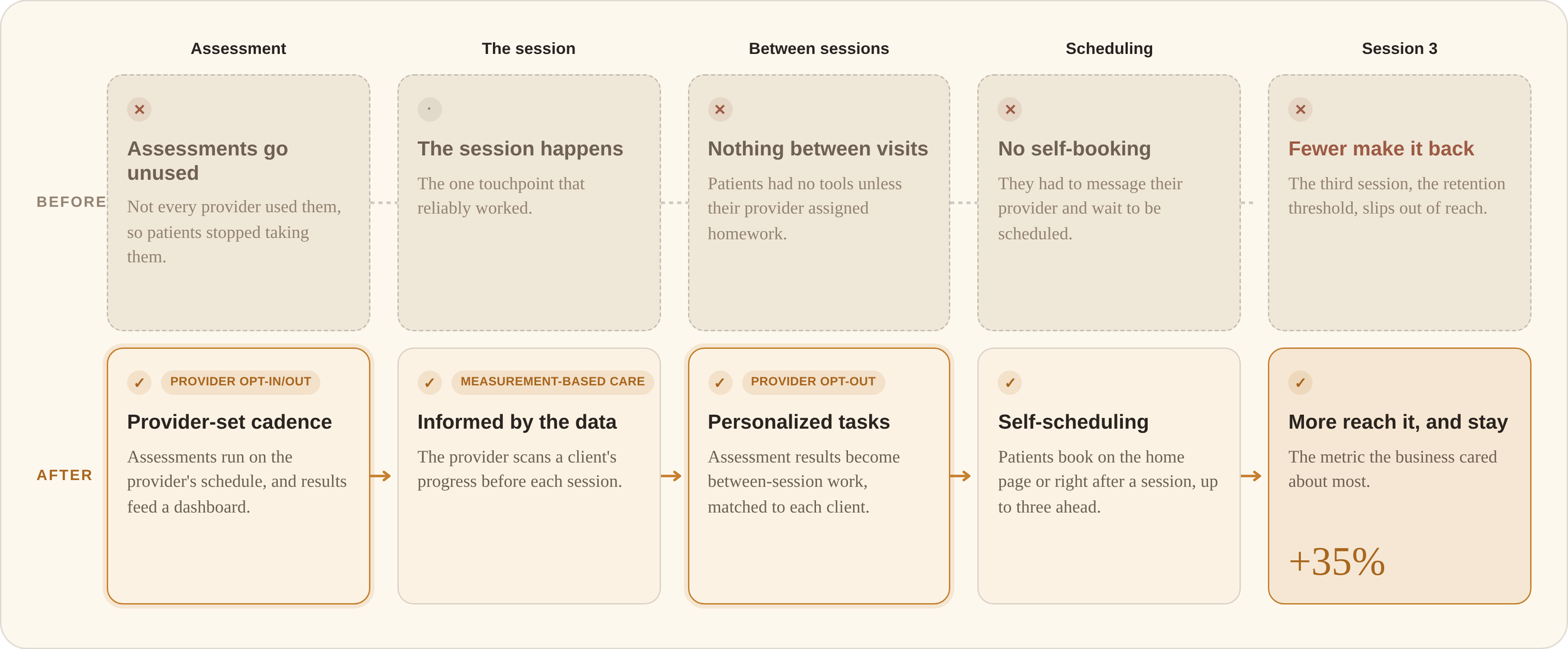
Care journey: before and after
Where relevance broke across the session cycle, and how the redesign closed it, so more clients reached a third session.
✕ Relevance broke ✓ Closed: providers in control
Assessment → personalized-task model
How a completed assessment became real between-session care, then looped back to providers as measurement-based care, with providers in control throughout.
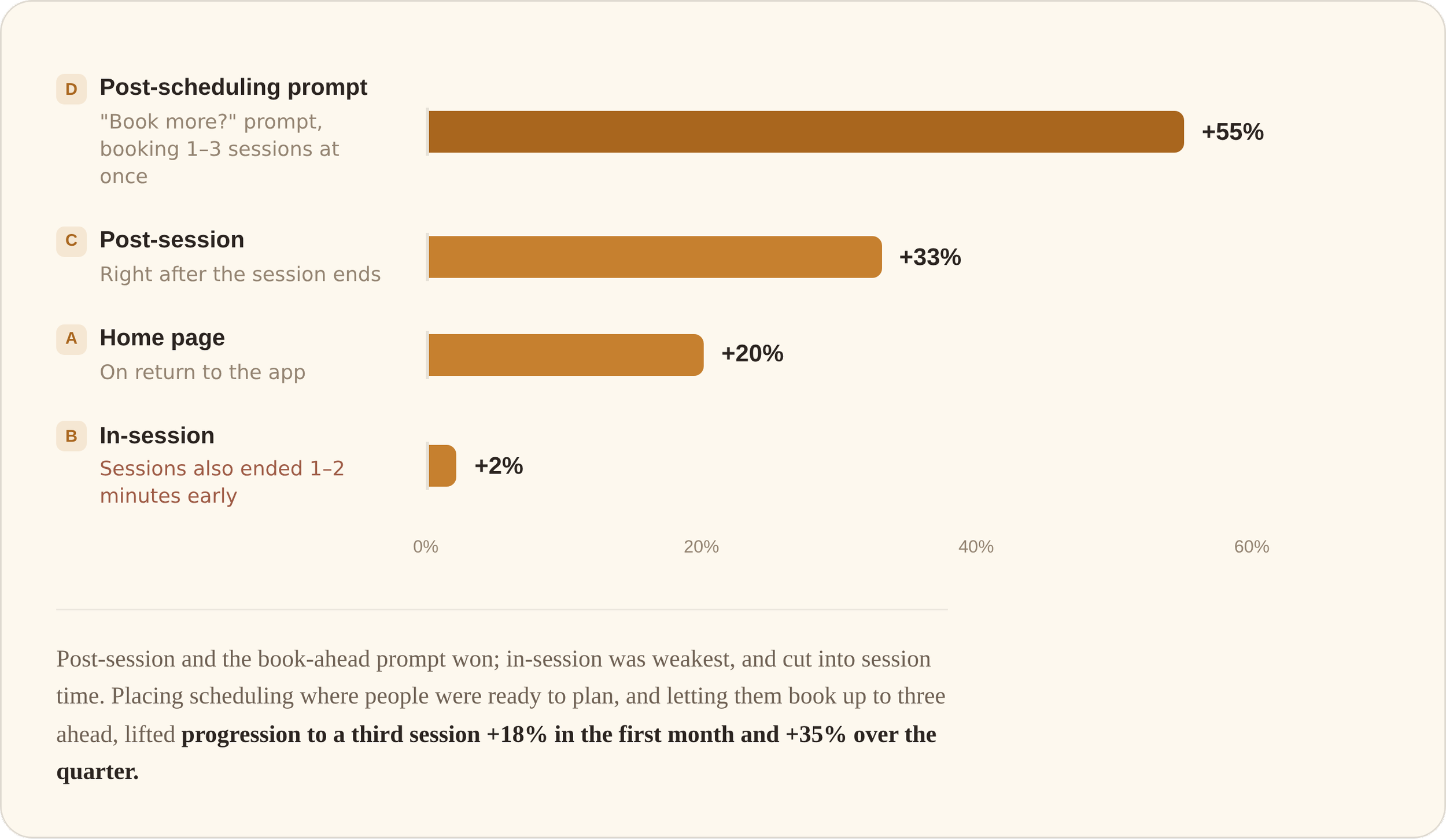
Scheduling lift by placement
An A/B/C/D test of where the "book your next session" prompt appeared. The intuitive choice, inside the session, was the weakest, and quietly cost session time.
Communication, rebuilt
From messages sent on the system's schedule to messages that arrive when they're useful, fewer of them, and worth opening.
WHAT I CARRY FORWARD
Personalization isn't enough. You have to meet people in the moment: the patient looking for support between sessions, and the provider who wants to stay in control of their practice.
From the Team
“Liz is a valuable member in technical discussions with engineers, and her strategic thinking and strong decision-making skills make collaboration and prioritization of technical and product initiatives a breeze.”
— Senior Staff Engineer
“She considered all edge cases so that we didn’t hit a roadblock when we were already building the feature. She asked for feedback so that I could be involved as early as possible.”
— Senior Software Engineer & Team Lead