Nobody was asking for AI. They were asking who was costing them money.
How I turned an open-ended "be more AI-forward" mandate into AI workflows customers actually adopted, by starting with what they wanted and keeping them in control of every decision.
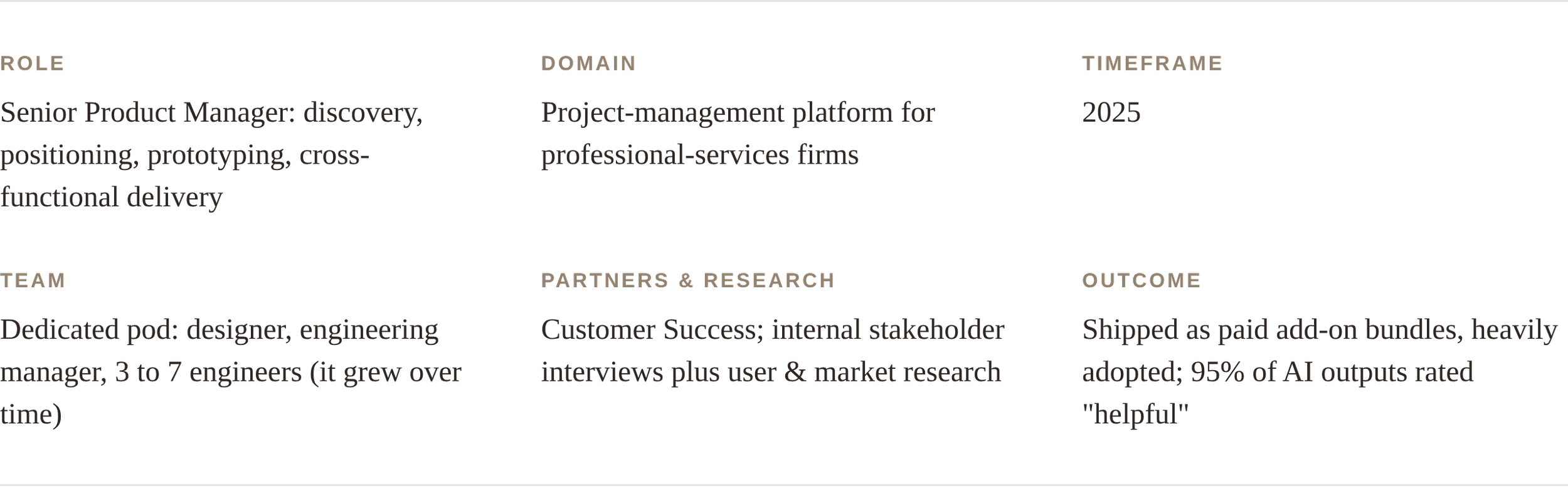
01 THE AMBIGUITY
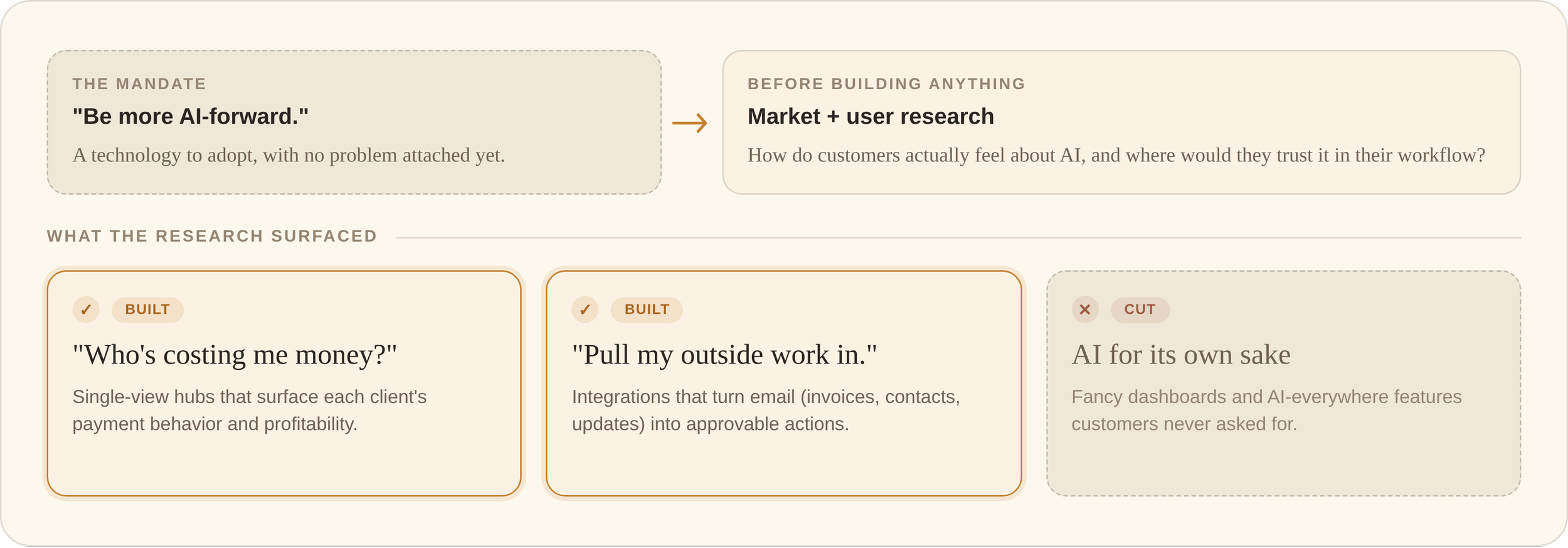
Leadership handed me "AI." Not a problem to solve, a technology to adopt.
The mandate was to become more AI-forward and figure out how it could help our customers: firms that run projects and bill for their time. Our CTO had working models, but there was no product or design thinking around what they'd actually do inside the platform, or why a customer would care. My job was to connect the dots across features, integrations, and positioning, and turn raw capability into something worth paying for.
The risk was everywhere in the industry that year: AI for its own sake. A pile of features no one asked for, bolted onto a product people already relied on. The real uncertainty was never whether we could ship AI. It was whether any of it would matter to the people paying us.
02 WHAT I DECIDED
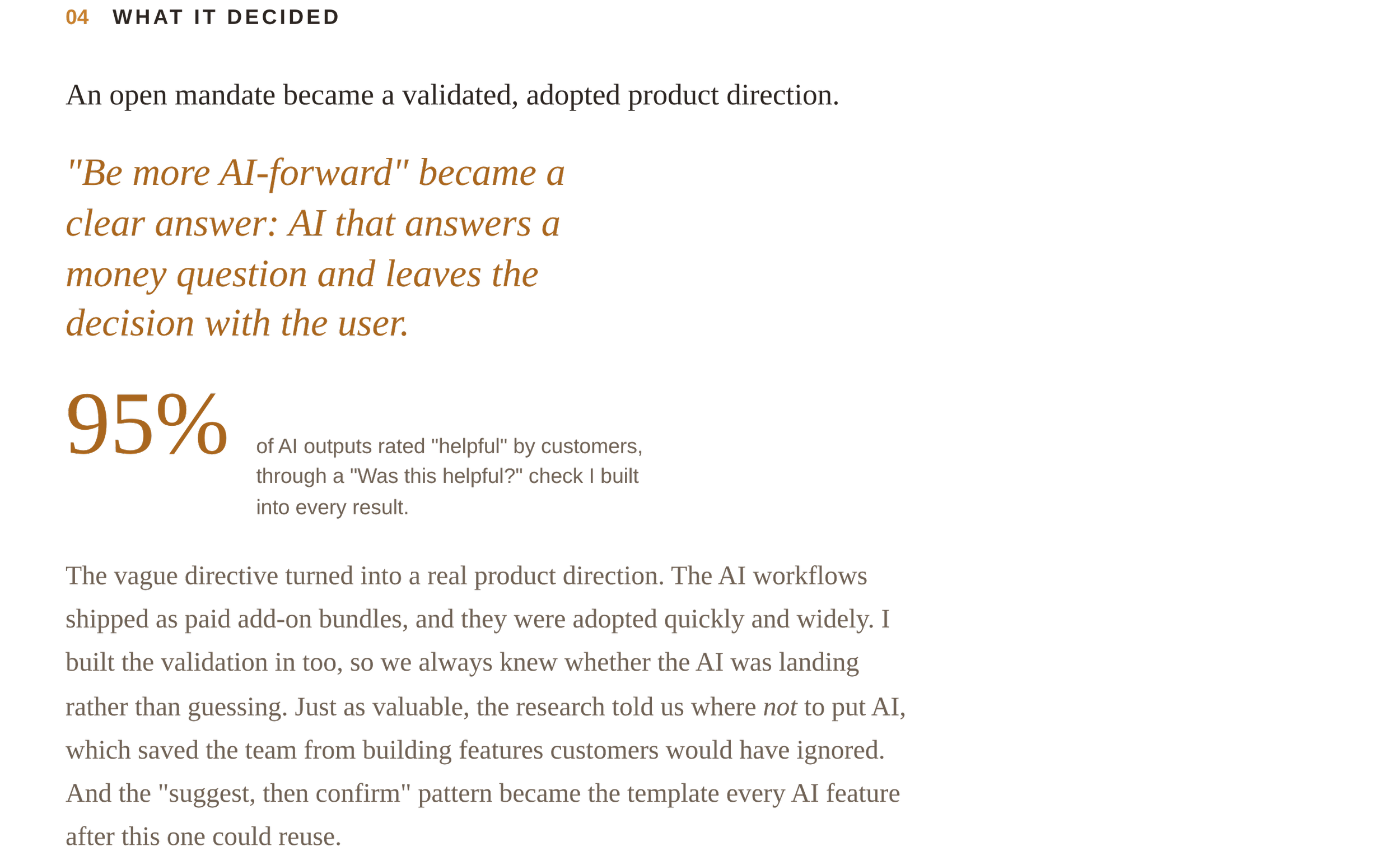
Three calls, and the first was to slow down before building anything.
DECISION 01 · RESEARCH BEFORE BUILDING
Resist putting AI into every use case, and start by asking how customers actually felt about it.
The pull was to ship AI fast and prove we were "AI-forward." I chose to do market and user research first. Before placement, before features, I wanted to know whether our customers even wanted AI in their workflow, where they'd trust it, and where they'd resent it. That sentiment is what shaped both positioning and placement: where AI belonged, and, just as importantly, where it didn't.
DECISION 02 · ACTIONABLE ANSWERS, NOT CLEVER SOFTWARE
Aim the AI at the questions customers actually cared about, starting with: who's costing me money?
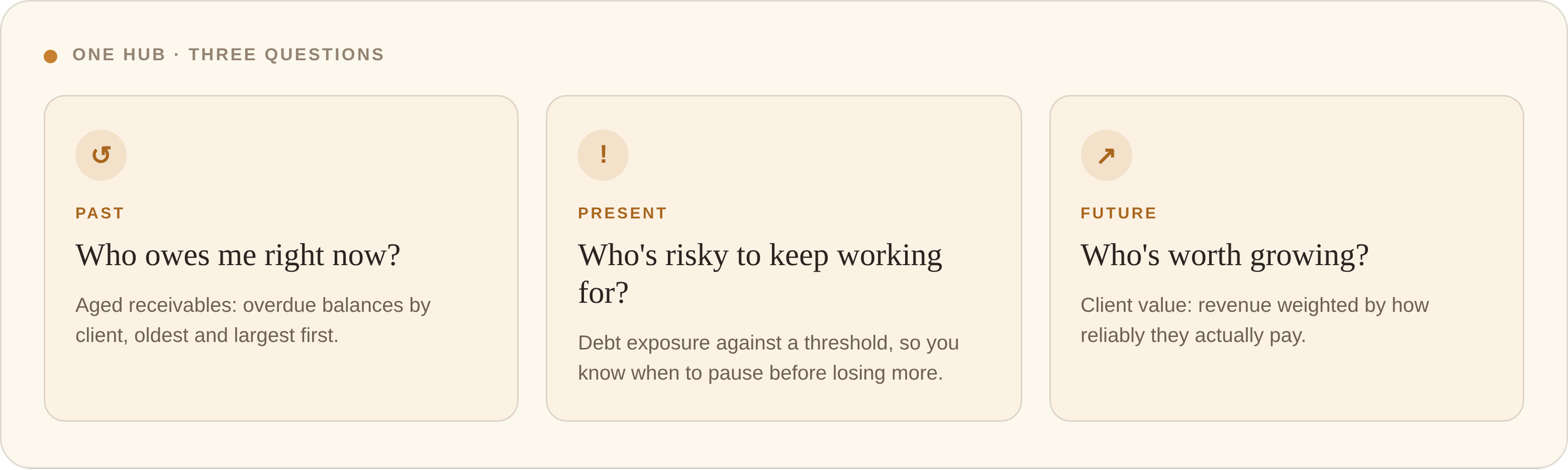
What customers wanted wasn't a fancier dashboard. They wanted straight answers tied to their bottom line. The first was "who's costing me money," so I built single-view hubs for each client and consultant that pulled their payment behavior and profitability into one place. I framed it around three questions: who owes me right now, who is risky to keep working for today, and who is worth growing next year. Past, present, and future, in one view.
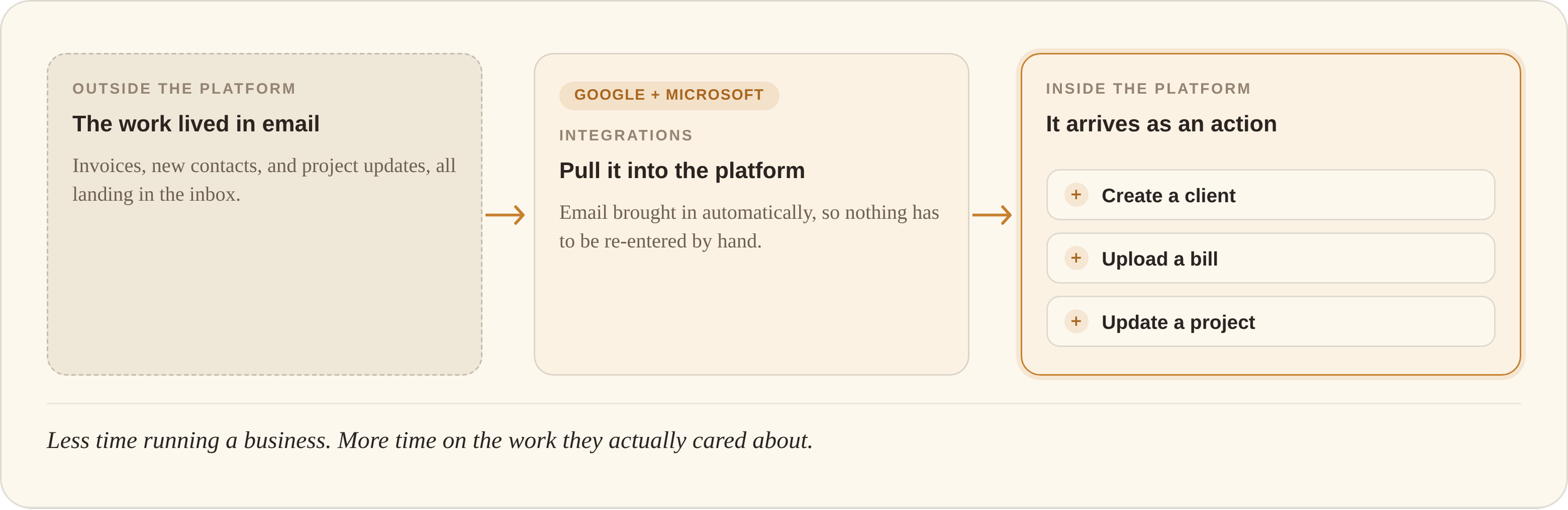
The second was to stop making customers run their business in two places. So much of the real work (a new invoice, a new contact, a project update) lived in their email, outside the platform. I built integrations with Google and Microsoft that pulled that work in and surfaced each item as an "action" the user could approve in one place: create this client, upload this bill, update this project.
DECISION 03 · KEEP THE HUMAN IN CONTROL
AI proposes an action; the user approves or denies it. No silent changes.
Every one of those actions waited for the user. Nothing was created, uploaded, or changed until they approved it. Getting the approve-or-deny pattern consistent across all the action types (new clients, bills, project updates) took several UI iterations. Once it clicked, customers trusted it, and adoption and real excitement followed.
WHAT IT GREW INTO
What started as a single inbox action became an ecosystem. The integrations pulled the work that happened outside the platform back into it, so customers could spend less time running a business and more time on the work they actually cared about. It all shipped as paid add-on bundles, chosen and paid for, not forced into the base experience.
03 WHAT CHANGED
The models behind the decisions.
From mandate to opportunities
How an open "be more AI-forward" brief turned into a short list of bets worth making, and the ones worth skipping.
The AI ecosystem
The work that ran a customer's business lived in their email. I built integrations to pull it back into the platform, where they could actually act on it.
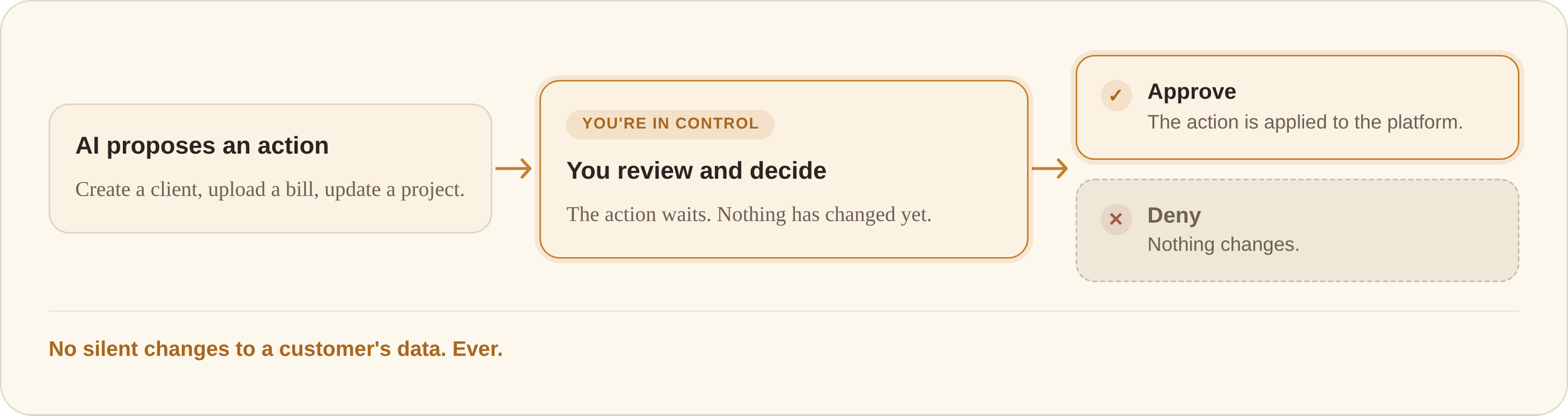
Approve or deny
The pattern behind every AI feature: a proposed action waits until the customer says yes.
Who's costing me money?
The most-wanted answer, built as one hub with three questions: a single view of every client's payment behavior across past, present, and future.
WHAT I CARRY FORWARD
People don't want AI to run their work. They want a straight answer to a real question, and the final say.
From the Team
“Liz has a sharp ability to connect product strategy to real user needs. She digs deep into the problem space, asks the right questions, and brings teams together around a clear, actionable vision.”
— Pod Senior Product Designer
“Liz brings thoughtful, informed perspectives that clearly reflect her understanding of both the product and the customer. She consistently provides timely feedback on questions and concerns—things that might otherwise slow down engineering progress.”
— Pod Software Engineer